Are You Setting SMART Weight Loss Goals?
The average dieter in the United States starts and abandons a weight-loss attempt roughly four or five times a year. Why? A big part of the answer comes down to whether the goals being set are actually SMART — or whether they’re quietly setting people up to fail. Table of content What Are SMART Goals? […]


The average dieter in the United States starts and abandons a weight-loss attempt roughly four or five times a year. Why? A big part of the answer comes down to whether the goals being set are actually SMART — or whether they’re quietly setting people up to fail.
SMART stands for Specific, Measurable, Achievable, Realistic, and Timely. Program abandonment often leads straight to weight regain, so learning to set SMART goals can make a real difference for anyone about to start a new diet or weight-loss plan.
Being SMART isn’t a measure of intelligence — it’s a widely used framework for lifestyle and behavior change, turning a vague intention like “I want to lose weight” into something with real, actionable direction. It works just as well for broad goals like quitting smoking as it does for specific ones like running a sub-24-minute 5K.
“As a counselor, I work with clients to see the importance of taking care of yourself, taking the time to meal prep, taking the time to work out, and taking the time to enjoy life. Positive lifestyle change is not an easy task; it will take time to regain the healthy behaviors and habits that you had before life happened. Wellness is hard, change is hard, being unhealthy is hard, and having health issues is hard. You have to pick which hard you are willing to work through,” says Jennifer Reynolds, EdS, LPC-S, a therapist at Talkspace.
What Are SMART Goals?
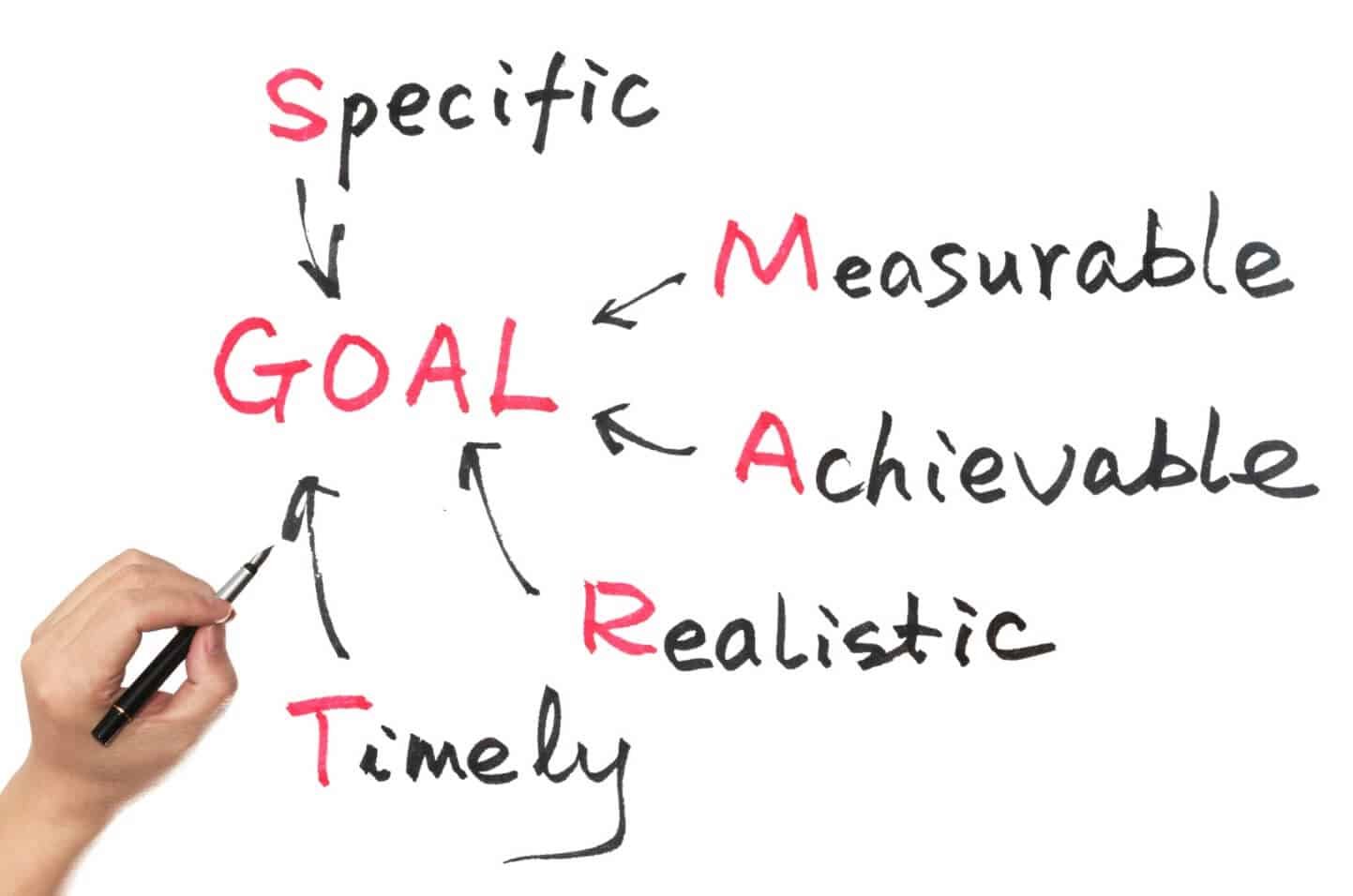
SMART goals take a vague intention and sharpen it into something clear and genuinely achievable.
- Specific — Clearly define exactly what you’re aiming to accomplish, in terms anyone could understand.
- Measurable — Decide how you’ll track progress and know when you’ve reached the goal. Outcomes are far easier to hit when there’s a concrete way to monitor them.
- Attainable — Does the goal genuinely stretch you while still staying within reach?
- Realistic — Is it within the realm of possibility given your current situation? Set the bar too low and procrastination creeps in; set it too high and stalled progress becomes discouraging. “Everything that happens to you is a reflection of what you believe about yourself. We cannot outperform our level of self-esteem. We cannot draw to ourselves more than we think we are worth,” says Sascha Alexander, a Life and Health Coach.
- Timely — Set a clear deadline. A defined timeframe gives the goal weight and a genuine sense of urgency.
SMART Weight Loss Goals: Setting Yourself Up for Success
SMART goals for weight loss can play out quickly or gradually, but for lasting results, a diet pill or appetite suppressant alone simply won’t cut it — a big reason so many people struggle to keep weight off long-term.
“Excuses also either go hand in hand with, or like to disguise themselves as, blame. Ever heard someone say, ‘I can’t lose weight because of my genes,’ or ‘because of my thyroid’? That’s someone blaming their circumstances and putting their body out of the realm of their control. While, yes, medically, some things may be more difficult for one body to accomplish when compared to another, that doesn’t mean that it can’t be done,” says Kimberly Spencer, coach, writer, and owner of Crown Yourself.
Real weight loss requires a genuine lifestyle shift, not a single tactic. “The ‘head-heart-hands’ approach for building new habits is the key for success. Take on lifestyle changes that appeal to the mind, emotions, and body. When you are starting new habits, make sure you exercise these three key areas,” says Thai Nguyen of The Utopian Life.
Since muscle weighs more than fat, a common question is how to burn fat, build muscle, and lose weight all at once. The answer: these three processes happen independently. Cutting calories and exercising can build muscle and lose fat simultaneously, though the pace differs — expect to lose roughly one to two pounds a week on a healthy diet, while building a single pound of muscle can take a month or longer.
It’s worth preparing for the likelihood of a plateau or even a small weight gain early on, since that moment can easily derail momentum and pull people back into old habits. This is exactly why SMART goals matter. “Goals & questions with neutral middle-of-the-road options create apathy, and are less likely to encourage behavior change,” notes Ioannis Kareklas, PhD.
Examples of SMART Weight Loss Goals
“Momentum is critical to winning the game of fitness. With that said, people often fall short of their goals because they lose perspective on their situation. For example, if someone wants to lose 20 pounds, they should set smaller benchmarks that are attainable in shorter periods. We all want to feel like winners, and when you set micro goals, you rig the game in your favor along with becoming more confident,” says Julian Hayes, a Certified Nutrition & Sleep Science coach.
Take a hypothetical client aiming to lose 40 pounds for a wedding in six months. At 5’7″ and 200 pounds, her BMI currently falls in the overweight range; losing 40 pounds would bring her into the normal, healthy range. Here’s how a SMART goal might break down for her:
Specific
Lose 40 pounds in 6 months, with a first milestone of 8 pounds in 5 weeks.
Measurable
The scale is the most straightforward measurement tool, though body composition and circumference measurements offer useful additional ways to track progress.
Attainable
Eight pounds in five weeks is a reasonable target, accounting for how the body typically adapts to new or adjusted physical activity.
Realistic
This pace keeps her on track for the full 40-pound, six-month goal without being unreasonably aggressive.
Timely
Five weeks is a sensible window for eight pounds, since losing half a pound to two pounds weekly is well within typical healthy ranges.

Individual SMART(er) Goals
Breaking a larger goal into smaller milestones makes it far easier to tell whether current changes are actually working.
Say this same client only loses five pounds in her first five weeks. On reflection, she realizes she hasn’t actually added any physical activity to her weekly routine — a clear signal to set SMARTer goals going forward. Five pounds isn’t a failure; it’s progress, just with room to improve. For her next five-week milestone, she adjusts by adding 30-60 minutes of physical activity three to five times a week.
The American Heart Association recommends 75 minutes of vigorous exercise weekly, or a combination totaling 150 minutes of moderate and vigorous activity — a guideline that aligns with Department of Health and Human Services recommendations. As she builds exercise into her routine, her overall health improves alongside her weight-loss progress, setting her up not just to lose the weight, but to keep it off.
The Bottom Line on Setting SMART Weight Loss Goals
The SMART method gives people a genuine sense of accomplishment and control throughout the process. Setbacks will happen, but reevaluating SMART goals along the way offers a clear path to course-correct rather than give up entirely.
Set a goal, then break it into small, achievable steps. “Wouldn’t it be easier if we could just set our mind to something and then do it? Don’t be discouraged; we humans need time to make changes. Even though the turtle-steps are absurdly small, they are the beginning of big change,” says Christine Carter, PhD.
Ultimately, results come down to a willingness to set and follow through on small milestones throughout the journey. For longer-duration goals, build in regular checkpoints along the way; for shorter ones, make sure progress can still be measured clearly and often.
Explore more Weight Loss Diet reviews and guides on our site.
For general guidance on healthy weight management, see the resources available from the CDC.